
By Thammachart Kulprapha Executive Director, IETL Co., Ltd. and Nonsi Co., Ltd.
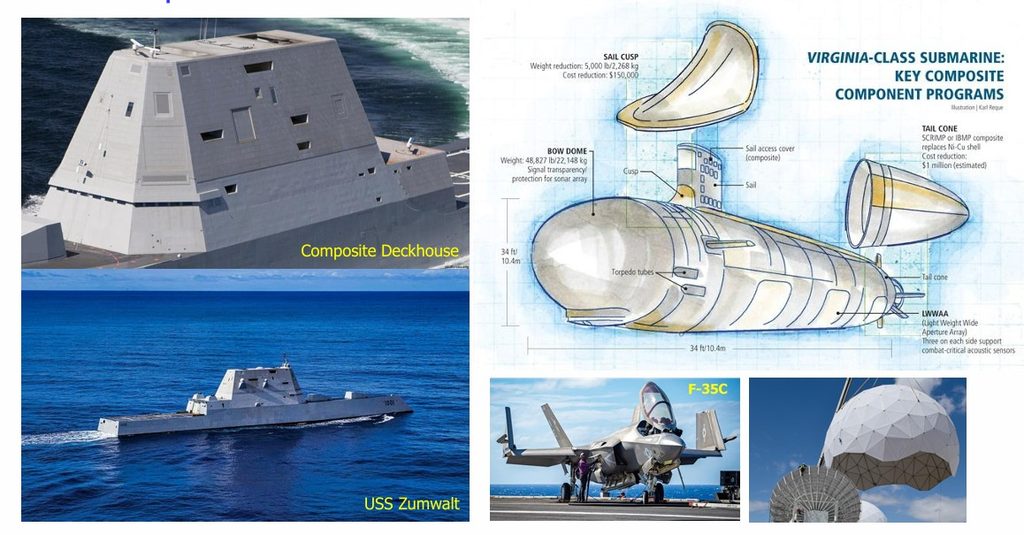
The development of operational capability among the world’s leading 21st-century armed forces points to the indispensable role of composite materials. Whether in unmanned aerial vehicles capable of sustaining missions for more than 24 hours, or body armor that is lighter in weight yet delivers a higher level of protective performance, an examination of how modern warfare is changing shows that although precision-guided munitions, unmanned aerial systems, and artificial intelligence tend to draw the most attention, composite materials — materials whose strength-to-weight ratio is many times greater than steel, whose density is lower than aluminum, and whose mechanical properties can be engineered for specific missions — are, in fact, the underlying infrastructure that makes all of these innovations possible.
Over the past decade, composite materials have significantly expanded their reach across every dimension of the defense industry: from bulletproof body armor for ground forces on Middle Eastern battlefields, to warships designed for a low radar cross-section, to high-performance unmanned aerial vehicles able to fly continuous missions lasting many hours, and more. For this reason, studying and understanding the performance of these materials is no longer a task for materials scientists alone — it has become a national security matter that Thailand can no longer afford to defer.
From the Laboratory to the Battlefield: Why Composites Rule the World
Composite materials are materials formed by combining two or more constituent materials at the macroscopic level, in which each component retains its own distinct physical and chemical identity, while the resulting material outperforms any single component considered on its own. Types widely applied in the defense industry include carbon-fiber-reinforced polymer (CFRP), which has a strength-to-weight ratio more than five times that of steel; Kevlar fiber, which efficiently absorbs the impact energy of a bullet; and UHMWPE (Dyneema), which has a lower density than water yet offers the highest level of protection against armor-piercing rounds.
“Composite materials are not simply about cutting weight —
they are about engineering a measurable operational advantage.”
The operational advantages are not confined to figures from the test lab. NIJ Level IV body armor weighing just 3.5 kilograms can stop a high-velocity .30 caliber armor-piercing round, compared with traditional metal armor that can weigh up to three times as much for the same level of protection. That weight reduction translates directly into greater mobility, less fatigue for troops, and a higher chance of survival in the field — factors that matter significantly in every type of military operation.
Sky and Sea: Composites on the Offensive
Perhaps the clearest illustration of what composites can do on the offensive is the MQ-9 Reaper, the United States Air Force’s autonomous strike drone, more than 60 percent of whose structure is made from CFRP. This gives it a payload capacity of up to 1,700 kilograms against an empty weight of only 2,223 kilograms — a payload-to-empty-weight ratio that traditional metal airframes simply cannot achieve. Among fighter aircraft, the F-35 Lightning II, now entering service with the armed forces of many nations, is built from composite materials in more than 35 percent of its structure, allowing it to preserve both radar-evading characteristics and structural strength at the same time. At an even higher level, the RQ-4 Global Hawk uses composites for more than 65 percent of its structure, enabling it to fly continuous missions of 34 hours at altitudes above 18,000 meters — well beyond the detection range of most ground-based radar systems.
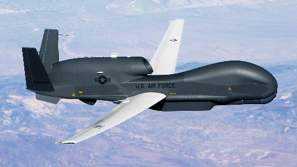
Fig 1. RQ-4 Global Hawk
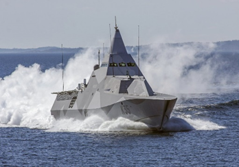
Fig 2. Visby-class Corvette
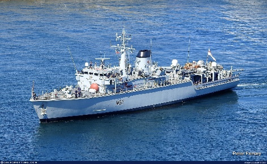
Fig 3. HMS Chiddingfold
In the maritime dimension, the Swedish Navy’s Visby-class corvette stands as a key reference case for applying composites to modern naval warfare. The entire hull is built from a carbon-fiber/vinyl-ester sandwich structure, giving the vessel an extremely low radar cross-section (RCS). Mine countermeasure vessels such as HMS Chiddingfold, meanwhile, are built entirely from GRP to eliminate the magnetic signature that could trigger the detonators of underwater mines — a technical requirement that traditional metal hulls simply cannot meet.
Composite materials are also central to unmanned underwater vehicles (UUVs), or “underwater drones.” CFRP and carbon-Kevlar hybrid structures allow these vehicles to withstand seawater pressure and corrosion, keep their acoustic signature low enough to resist detection, and maintain precise buoyancy control while using less energy. Boeing’s Echo Voyager, for example, can carry out reconnaissance, mine-laying and mine-detection, and even intercept data from undersea cables continuously for more than six months without needing a mother ship — a capability of considerable importance to a number of countries’ key military missions.
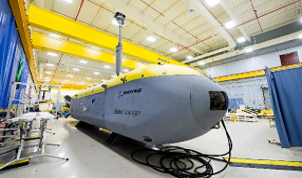
Fig 4. Boeing Echo Voyager
Beyond Warfare: The Value of Composites in Peacetime
Beyond their applications in wartime, composite materials also play an important role in military operations other than war (MOOTW), covering disaster relief, peacekeeping, and humanitarian assistance. In flood or earthquake situations, FRP bridges spanning 20 to 50 meters can be airlifted and assembled within six hours without the need for a crane. GFRP casualty stretchers can carry 250 kilograms of weight while weighing only 4 kilograms — half the weight of a standard aluminum stretcher. These weight advantages translate directly into faster operations and more effective life-saving missions.
Critical infrastructure protection (CIP) — covering power plants, water systems, and telecommunications networks — likewise relies on composites in various forms: acid- and alkali-resistant FRP piping for nuclear power plants, corrosion-free, wind-resistant transmission poles, and radomes that are transparent to electromagnetic waves while withstanding extreme weather. All of these are indispensable components of a modern national security system, particularly in an era when contemporary conflicts often begin with attacks on critical infrastructure before any direct clash of armed forces.
“The nation that commands advanced materials technology is the nation that
commands the strategic advantage of the century to come.”
Thailand’s Opportunity: Self-Reliance Before It’s Too Late
At present, Thailand still relies primarily on importing finished composite defense equipment from abroad, which creates risks in terms of cost, flexibility in customizing to specific needs, and the resilience of the supply chain in times of crisis. In a military emergency, in particular, the delivery of spare parts and maintenance components from overseas manufacturers could be suspended or significantly delayed. Even so, Thailand possesses considerable industrial capital to build on, including a strong private-sector composite manufacturing base, accumulated expertise from the sporting-goods and civil aviation industries, and basic raw materials — high-tensile fibers and various polymer resins — that are available domestically at competitive prices.
A concrete path forward should begin with establishing a Defense-Academia-Industry Triad that integrates the armed forces, academic institutions, and industry, in order to translate accumulated knowledge into actual production. This should go hand in hand with developing a standard composite MOOTW package comprising field bridges, transport equipment, antennas, propellers, mobile field hospitals, and prefabricated bunkers that can be delivered by air. In addition, establishing international-standard testing and certification laboratories would open the door for domestically manufactured products to compete in export markets over the long term.
Composite materials are not a technology waiting to be developed at some point in the future — they are a strategic component in which the world’s leading armed forces are investing continuously, right now. Any country that delays investing in this area will face a capability gap that keeps widening and becomes progressively harder to close. In the author’s view, Thailand’s armed forces and industrial sector alike have sufficient resources and potential to move beyond import dependence toward self-reliance, and ultimately toward exporting defense technology under Thailand’s own name. What is essential to achieving this goal is for policymakers to recognize its importance and to provide clear, integrated cooperation and strategic planning.
Image Sources
Fig 1. Wolf, F. (n.d.). RQ-4 Global Hawk. Meta-Defense. Retrieved from https://meta-defense.fr/en/author/ymb99t9hxq/
Fig 2. Carrushome.com. (n.d.). Visby class corvettes — Sweden’s stealth patrol corvettes. Carrushome.com. Retrieved from https://www.carrushome.com/visby-class-corvettes/
Fig 3 ShipSpotting.com. (n.d.). HMS Chiddingfold M37 (IMO 4906654). ShipSpotting.com. Retrieved from https://www.shipspotting.com/photos/3168331
Fig 4. Fingas, J. (2016, March 9). Boeing’s monstrous underwater robot can wander the ocean for 6 months. WIRED. Retrieved from https://www.wired.com/2016/03/boeings-monstrous-underwater-robot-can-wander-ocean-6-months/